Why the hard problem in renewable desalination is timing, not efficiency.
Sixty years of progress
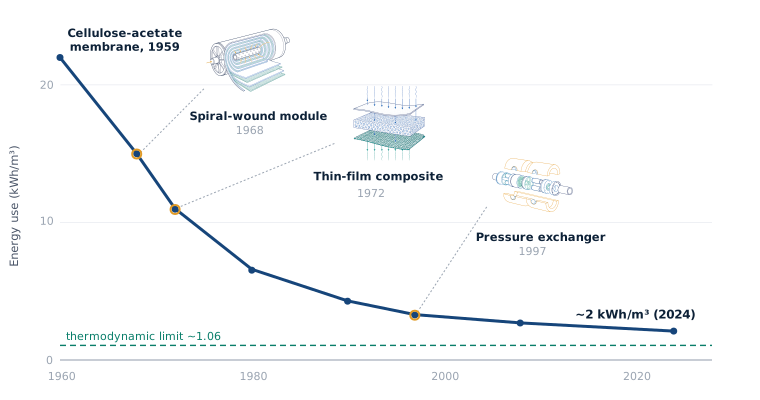
Seawater reverse osmosis is a mature technology. Since the first practical membranes arrived in 1960, engineers have driven the energy needed to desalinate a cubic meter of seawater down from more than twenty kilowatt-hours to roughly two to three and a half today, within reach of the thermodynamic floor near one kilowatt-hour that no design can beat. That is one of the quiet triumphs of process engineering. It also means the remaining gains are necessarily incremental. You cannot out-engineer physics, so each new fraction of a percent costs more and returns less.
What changed
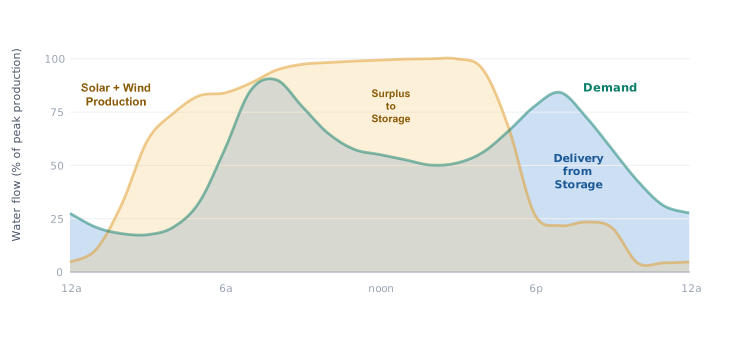
Efficiency only ever mattered because it lowered the cost of power, and a desalination plant needs power every hour it runs. For decades that power came from the grid at a known, roughly steady price, so using less of it was the only lever worth pulling. Renewable energy breaks that assumption. Solar and wind now generate electricity below grid prices in much of the world, but only while the sun is up or the wind blows. At midday a solar kilowatt-hour at the point of generation is nearly free, and on sunny days wholesale prices routinely fall below zero. The same kilowatt-hour at midnight is expensive, because it has to be stored or made from fuel. So the cost of desalinated water now turns less on how efficiently each kilowatt-hour is used and more on when it is used, a question the field has rarely had to ask, because almost all installed capacity runs on the grid, where timing is somebody else's problem.
The obvious answer
The power industry's answer to intermittency is energy storage. Size a battery bank large enough to buffer the renewables, and the plant sees something close to steady grid power again. It works, but it is expensive in a way that does not go away. A battery big enough to carry a plant through the night is a major capital outlay, and unlike the rest of the system it wears out. Its capacity fades over a decade or so, and the pack has to be replaced within the life of the project. In effect, you pay, again and again, for the privilege of running your plant at the wrong time of day.
The reframe
If the goal is a steady supply of water from an intermittent energy source, there is a far cheaper buffer than a battery. It is the water. Instead of storing electricity to keep a small plant running around the clock, run a larger plant while energy is abundant and store what it makes. Water tanks are about as simple as infrastructure gets. They do not degrade, need no thermal management, last for decades, and return very nearly everything you put in. The plant has to be sized up to make its day's water in fewer hours, but that is a one-time, non-degrading piece of equipment, not a consumable bought over and over. Store water, not electrons.
Making it work
Running this way turns operation into a real-time decision. At every moment, with only a small buffer of battery, an hour or two at most, the system must choose whether to spend this kilowatt-hour making water now or hold it for later, weighing the weather forecast, how full the tanks are, and the state of the plant. Simple fixed rules fail at the edges. They waste energy when the buffer fills and fall short of water during long cloudy spells. Modulus runs a predictive controller against a digital twin of the whole system. Across a full year of real weather, it produces more than ninety percent of the water a perfect, all-knowing controller could make from the same renewable energy, without a battery bank to lean on.
One fleet, two markets
Because the units are containerized and mobile, one fleet serves two very different demands. Agriculture is high-volume, seasonal but predictable, and price-sensitive, the steady work that keeps the equipment earning. Emergency response is the opposite, sporadic and urgent and acutely valuable when it happens. The reverse-osmosis hardware runs the same way in both. Only the deployment pattern and the contract change.
Beyond the base case
A deployed unit is a dispatchable, fuel-free asset with predictable output, which makes it financeable the way utility-scale renewables are, and a natural fit for the development-finance institutions that fund water infrastructure in emerging markets. And because irrigating arid land grows vegetation and builds soil carbon where there was none, the approach opens a credible path to carbon value. None of that is required for the core logic to hold. Storing water instead of electrons stands on its own.
Sources
Lienhard V, J. H. (2019). Energy savings in desalination technologies: reducing entropy generation by transport processes. Journal of Heat Transfer, 141(7), 072001. doi:10.1115/1.4043571
Tafech, A., Milani, D., & Abbas, A. (2016). Water storage instead of energy storage for desalination powered by renewable energy: King Island case study. Energies, 9(10), 839. doi:10.3390/en9100839
Rao, A. K., Bolorinos, J., Musabandesu, E., Chapin, F. T., & Mauter, M. S. (2024). Valuing energy flexibility from water systems. Nature Water, 2(10), 1028–1037. doi:10.1038/s44221-024-00316-4